AI has arrived in such a big way it’s hard to picture work life without it. It’s in our inboxes and chat windows, helping us solve problems every day.
Just how prevalent is it? A recent EY survey found that 68% of Australian workers now use AI at work. Here’s the kicker though – 72% of those same workers worry about breaking data or regulatory rules when using it, and only 35% have received any formal AI training.
In fact, according to one law firm, only around 30% of employers have a formal policy governing AI use. For an exceptionally powerful tool, that’s a big governance gap.
Not part of that 30%? Your business needs a framework to guide your AI use. Implementing it ASAP will help protect your people, data, customers and reputation.
Today, we’re going to go over five practical rules that will help you get started.
AI Workplace Rules
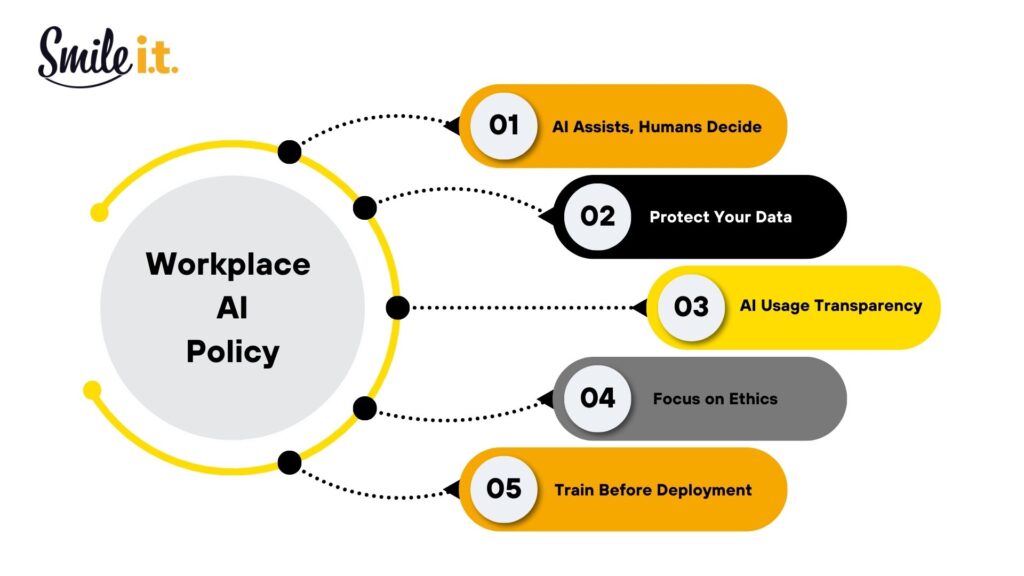
1: Let AI Assist and Humans Decide
AI works at its best when it has human input and oversight. AI should support team members without replacing their professional judgment. Every output should be reviewed and approved by a human, without exception. Not doing this can have serious impacts on compliance, clients, decision-making and even safety.
Human judgment is a powerful governance tool. Here’s how to combine that with AI for results that enhance productivity while retaining compliance:
- Define where AI can be used in the organisation. Implement boundaries about what decisions need human sign-off: client proposals, legal language, public content, and any automated communication definitely do.
- Assign ownership: Every AI-assisted output needs a team member to assume accountability.
2: Protect Your Data.
Data is integral to functional AI. From a safety standpoint, it’s imperative that sensitive internal data is kept away from public AI tools.
The best approach to this is to consider whether you would post the data in question in a public forum. If the answer is no, then it shouldn’t be uploaded to AI.
The following are data types that need protecting:
- Client data and personal information
- Financials and proprietary strategy
- Security configurations
- Customer support logs
- Legal or compliance documents
Because most Australian businesses don’t have their AI policy nailed down, lots of the wrong information is finding its way into AI tools. The following steps will help prevent this:
- The education of your team is extremely important. If there’s going to be accountability, they need to know what they can and cannot share.
- Whitelist enterprise AI tools that meet your security requirements.
- Block or restrict access to public AI tools from company networks where appropriate.
- Audit usage to catch risky behaviours early.
3: Be Transparent About AI Usage
AI should never be a secret. People deserve to know when AI played a role in creating something they see, hear, or interact with. From customer support messaging to client proposals, it’s important to state if AI has been used in it’s creation.
What this does is twofold – you build trust internally and externally, while also protecting your business from claims of misrepresentation or misleading conduct.
In a world where 70% of Australian businesses don’t have a defined AI policy, your transparency could become a competitive advantage. Here are a couple of things you can do to implement this:
- If any output has been AI-assisted, label it as such. This could look like: “Drafted with the assistance of AI; reviewed by [Name]”.
- Educate managers about acceptable AI use within their teams. There needs to be constant discourse around what AI can be used for to help maintain transparency.
4: Focus on Ethics.
AI has no moral compass. It reflects the standards you set. If your culture cuts corners, your AI use will too. If you’re a value-driven organisation, with a strong focus on ethics, you want that to be reflected in your AI output. Here are a few steps to achieve that:
How to apply this:
- Build your values into your AI guidelines.
- Ban misleading or discriminatory uses.
- Require fairness and respect in all AI outputs.
- Add ethical review steps.
5: Train Before You Deploy.
Let’s go back to that EY case study. Here’s another stat it contains: Only 35% of all AI users in Australian businesses have received formal training.
So this new and powerful technology, we’re all just figuring it out as we go? That sounds like a breeding ground for mistakes.
Get ahead of the curve and implement AI training for your team. It can’t just be a one-off either – it needs to be ongoing to match the evolution of AI. Don’t just teach how to use AI, teach how to recognise bias in it, how to validate outputs and when not to use it.

Smart AI Use with Less Risk
AI governance allows it to grow in your organisation in the right way. You give your team the tools, rules, confidence, and judgment to use AI responsibly and creatively. It’s about embracing the technology and growing with it.
Australian workplaces are already knee deep in AI. Don’t resist it – just guide it and your business in a positive direction. Make it a safe addition to your technology stack – that way, you’ll maximise the productivity boost and competitive edge it brings.
AI is here to stay, and your governance strategy should be too. If you have any questions or need some guidance with this, don’t hesitate to get in touch with the Smile IT team.

When he’s not writing tech articles or turning IT startups into established and consistent managed service providers, Peter Drummond can be found kitesurfing on the Gold Coast or hanging out with his family!